Euro-Soccer and Hellenomania
University of Michigan Window to Greek Culture
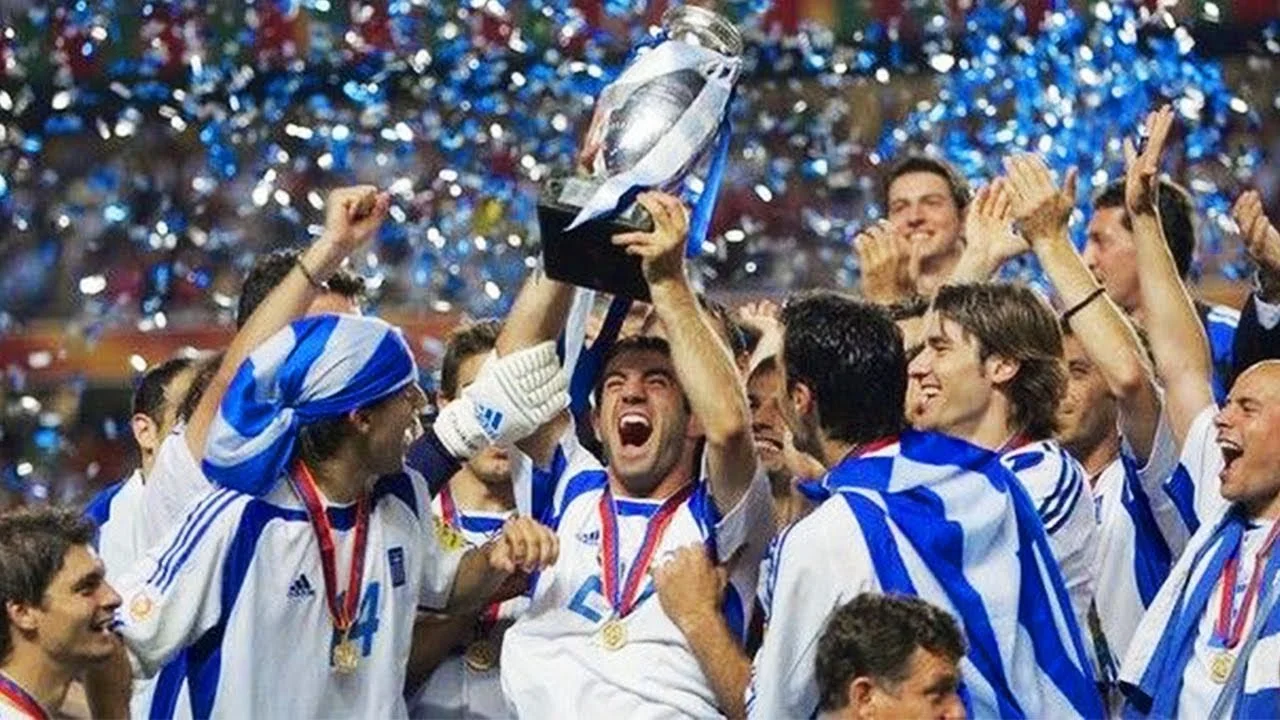
The fact that Greece even got to the Euro Cup Finals in Portugal was considered a great achievement, and people just hoped for a dignified performance, even if the team was not to make it past the first rounds. As victories started coming, Greeks responded with a sense of wonder. Getting to the quarter finals against France, the defending champions, was considered a miracle. This opinion was shared not merely by soccer aficionados worldwide but also by the entirety of the Greek population, who responded to the prospect of this game without anxiety but rather a sense of historic opportunity. Every step of the way was considered unrepeatable; hence the gravity of the response after every repetition. This all- consuming sense of wonder and of making history produced a public response that surpassed the celebration for the fall of Junta or the liberation from Nazi occupation. After each match the streets exploded, culminating in a panhellenic delirium that reached Dionysean proportions of blissful madness. My own experience in the streets during the night of final victory showed that the celebration broke every single barrier of difference among the population -- not merely lines of age, sex, class, and political affiliation, but the very ethnic lines of difference as well. I saw immigrants of all races and cultures swept up in the flood of celebration, waving the ubiquitous Greek plastic flags, chanting along the makeshift slogans that became the anthems of those days.
Any attempt to consider this spontaneous Hellenomania an instance of nationalist paroxysm is way off base. This sudden, all-consuming adoration of all things Greek had nothing ideological about it; it was, in my terms, purely mythological. Utterly explosive and all embracing, unorganized and unguided by any political force, unreflective of any grand image or "Great Idea," it continued throughout, in the depths of bliss, to carry a sense of the miraculous. The people hit the streets after the three elimination matches as if the Cup had been won in each case -- the reaction of a population enjoying something beyond its wildest expectations. The climactic celebration from victory to victory carried intact the sense of disbelief, of utter astonishment, even after the indisputable finality of the championship victory. But what drove the entire country out into the streets was also the sense that this "miracle" was neither a matter of luck or good fortune, nor due to someone else's good graces, nor achieved by dubious or foul means. What fortified our sense of wonder was that we achieved this victory because in the end we were simply the best, we gave the best performance. This realization does not come often to Greeks. The sheer fact of superior achievement without anybody else's help and without bending the rules has a sense of the miraculous in the Greek experience, and it registered all the more as miraculous because it was indeed a fact.
I am convinced that no political achievement could have produced such broad celebration, such a deep sense of wonder, such collective cohesion. In contemporary societies, the political cannot achieve such direct access to the mythological. Ideological principles and mechanisms are insurmountable; the agents of political 'expertise' codify all contact with the population. But soccer is a sport-spectacle that has come to carry a mythological power analogous to ritual and theater in archaic societies. It is the world's most popular spectacle because, especially at the national team level, it serves as a symbolic enactment of cultural antagonism, if not outright war, by creating occasions of symbolic communion and collective sentiment actualized within strict parameters of opposition. People, who may have never owned a flag, who may be indifferent or, even more, may detest the flag, can show up en masse in the soccer stadium with a flag painted on their own bodies in sheer embodiment of the symbolic which nationalist ideologues surely envy. By analogy, professional players, who at the club level exist in conditions of free globalized trade, return to their national teams to blend into a "national style" of play which is itself an indelible part of the symbolic economy.
In these conditions of symbolic war, expertly conducted and formalized within professional parameters, a Greek team without super star players (by market standards) showed an uncanny mix of team discipline, defensive alertness, and momentary individual ingenuity to achieve not just victory but superiority recognized by all. In no other sphere -- of politics, economy, technology, or the arts -- has Greece ever showed such crystal clear achievement, such high quality in execution. The population's unbounded expression was also a mark of appreciation for just that: the showing of consistency, dedication, and commitment to the task: the very thing that as a society, as an aggregate of individual actions, it has not been able to achieve, it has not thought itself capable of achieving.